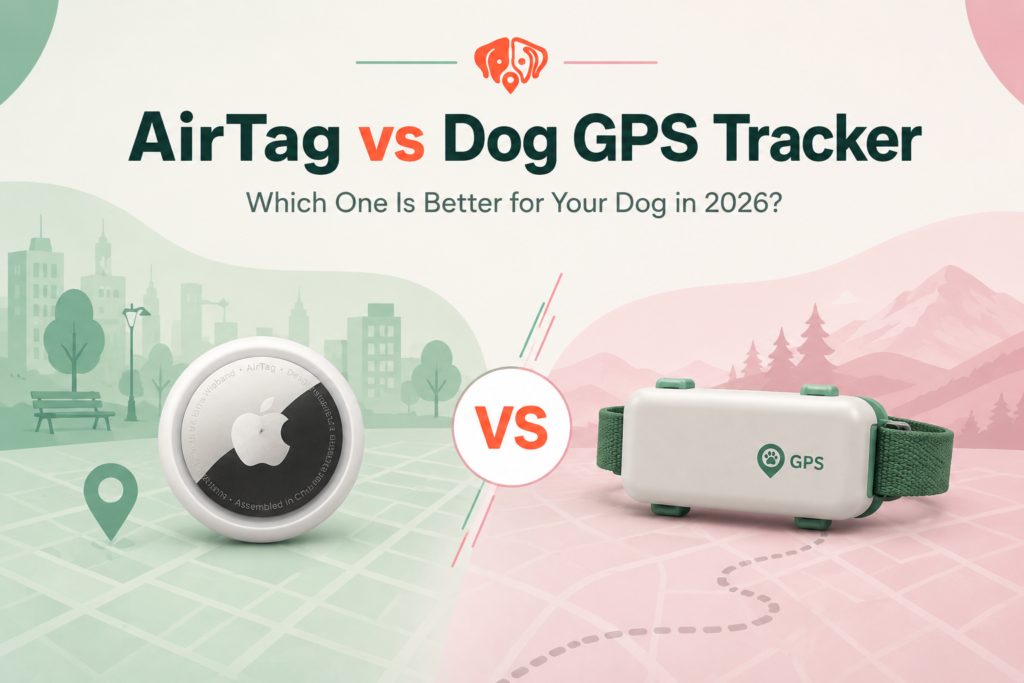
AirTag vs Dog GPS Tracker: Which One Is Better for Your Dog in 2026?
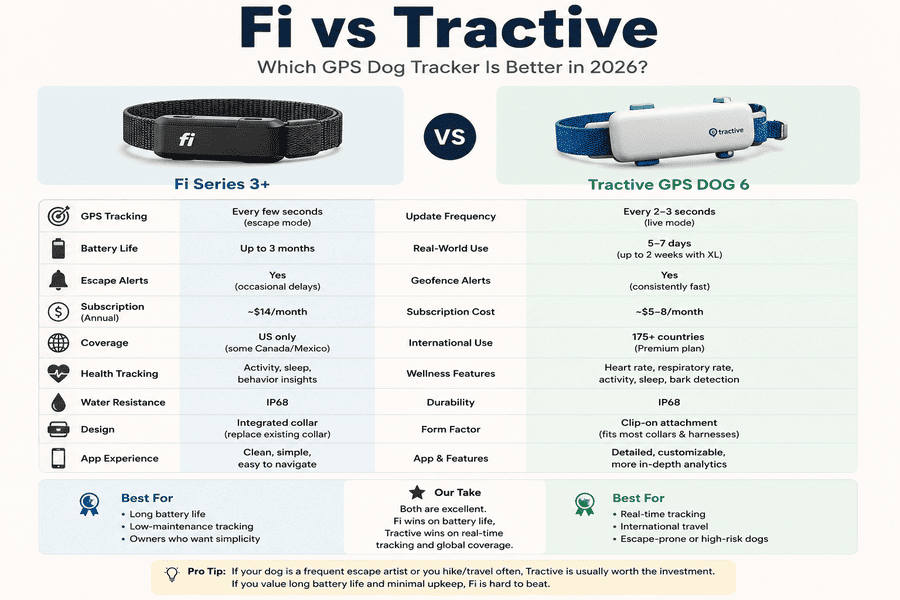
When I first started researching GPS dog trackers, Tractive was one of the first options that caught my attention.
On paper, it looked like one of the best solutions available. Real-time tracking, escape alerts, and GPS coverage in dozens of countries made it seem like an easy choice.
But while looking into subscription availability, I ran into a problem: Tractive support was still limited in Bali, where I currently run a pet care and pet-sitting business. That led me to a bigger question:
Can an AirTag actually replace a GPS dog tracker?
At first, I assumed the answer would be obvious. GPS trackers are designed specifically for tracking pets, while AirTags were created to help people find keys, wallets, and other everyday items. But the more I researched how these devices perform in real-world situations, the less obvious the answer became.
Because in some situations, an AirTag is more than enough. And in others, a GPS tracker is the only reliable option. That’s exactly what this comparison is about.
Quick Verdict
AirTag is a reasonable backup tracker for dogs in urban or suburban areas where Apple device density is high. It’s genuinely useful, nearly effortless to maintain, and costs almost nothing to run. For certain dogs and certain lifestyles, it’s enough.
A dedicated GPS tracker is the right primary tool if your dog has any real escape risk, you spend time outdoors in lower-density areas, or you want real-time tracking and geofence alerts. The subscription cost is the main barrier, but it buys you a meaningfully different level of capability.
The biggest mistake is thinking they’re interchangeable. They’re built on different technologies, serve different roles, and fail in completely different ways.
How Each One Actually Works
How AirTag Works
AirTag uses Bluetooth Low Energy to broadcast a signal. When your dog wanders off, any nearby iPhone, iPad, or Mac within roughly 30–50 feet can silently detect that signal and relay your AirTag’s location to Apple’s servers via end-to-end encryption. You see the last detected location on your Find My map.
There’s no GPS chip inside an AirTag. There’s no cellular connection. The entire system depends on other Apple devices passing within Bluetooth range of your dog and reporting back. In a city where millions of iPhones are always nearby, this can work remarkably well. In a quiet suburb at 2am, or on a hiking trail, the system can go hours without a single update.
AirTag also has a built-in speaker and Ultra-Wideband (UWB) precision finding — when you get physically close to your dog, your iPhone can use directional cues to guide you within a few feet of the AirTag. That’s genuinely useful for locating a dog hiding under a porch or behind a fence.
Battery life: approximately one year on a standard CR2032 coin cell, which is user-replaceable. No charging required.
How a Dedicated GPS Dog Tracker Works
A GPS tracker like the Tractive GPS DOG 6 or Fi Series 3+ contains two separate systems working together: a GPS chip that communicates with satellites to determine your dog’s precise location, and a cellular radio (4G LTE-M) that transmits that location to your phone over the mobile network.
This means the tracker doesn’t need any other devices nearby to work. As long as there’s cellular coverage in the area, you can see your dog’s location in real time — whether you’re standing next to them or sitting at home across the city.
Most GPS trackers update location every few seconds during an active tracking session. They support custom geofences (virtual boundaries around your yard or a park) that trigger instant push notifications the moment your dog crosses them. You can watch a moving dot on a map as your dog runs. That’s a categorically different experience from the AirTag’s passive, crowd-dependent update system.
The Biggest Difference That Actually Matters
A lot of comparisons focus on accuracy numbers and technical specs. The more useful distinction is simpler:
AirTag is passive. A GPS tracker is active.
With an AirTag, you don’t know your dog is missing until you look at the app and realize the location hasn’t updated in a while. You might discover your dog has been two blocks away for the past hour — or you might open the app and see no update since yesterday morning, because they ran somewhere quiet.
With a GPS tracker, the device tells you. The moment your dog steps outside a geofence, your phone buzzes. You don’t have to check. The tracker assumes you’re busy, distracted, or asleep, and it takes the initiative.
That proactive escape alert is the feature that matters most when you actually need it. And it’s something AirTag fundamentally cannot offer.
Where AirTag Works Surprisingly Well
It’s worth being honest here, because a lot of GPS tracker comparisons unfairly dismiss AirTag as useless for pets. That’s not quite right.
Dense Urban Environments
In a city like New York, Chicago, San Francisco, or London, the density of Apple devices is extraordinary. Hundreds of iPhones might pass within range of your dog over the course of an hour. In this environment, an AirTag can provide surprisingly frequent location updates — sometimes every few minutes — without any subscription cost.
If you live in an apartment building, take your dog to busy parks, and walk on populated streets, an AirTag covers a lot of real-world scenarios reasonably well. It won’t give you live tracking, but it gives you a general location picture that’s often good enough to go find your dog.
Low-Risk Dogs in Managed Environments
Not every dog is an escape artist. Some dogs are reliably on-leash, live in apartments without yard access, or are senior dogs with very limited interest in wandering. For a calm older dog in a managed city environment, an AirTag offers a meaningful safety net at essentially no ongoing cost.
It’s also useful as a secondary layer alongside a GPS tracker — if the GPS tracker’s battery dies or loses signal, the AirTag keeps working. Several experienced dog owners use both.
Budget-Constrained Situations
GPS tracker subscriptions run $60–170+ per year depending on the provider and plan. For dog owners managing tight budgets — or anyone with a dog they’re fostering temporarily — an AirTag is a practical short-term option that costs around $29 once and nothing after that. Imperfect safety coverage is meaningfully better than none.
Finding a Dog That’s Already Stopped Moving
Once a dog has settled somewhere — hiding in a backyard, curled up under a neighbor’s porch, stuck behind a fence — the AirTag’s precision finding mode becomes genuinely useful. When you’re already in the right neighborhood, the directional arrow on your iPhone can guide you to within a few feet of your dog. That last-mile guidance works well and works reliably.
Where GPS Trackers Become Much More Reliable
Escape Alerts and Real-Time Awareness
This is the clearest gap. A GPS tracker with geofencing watches your yard while you’re inside making dinner. The moment your dog squeezes through a fence gap, your phone buzzes. You can be outside within thirty seconds.
With an AirTag, you might not notice for an hour. By then your dog could be miles away in a direction you have no information about.
Quiet Suburban and Rural Areas
The AirTag’s Find My network depends entirely on iPhone density. In lower-density suburbs — quiet residential streets at night, small towns, rural areas — the crowd thins out dramatically. Your dog could wander for hours with no nearby Apple devices to relay their location.
GPS trackers don’t have this problem. They talk directly to cell towers, not to other people’s phones. As long as LTE coverage exists in the area, the tracker works.
Off-Leash Hiking and Outdoor Adventures
This is where the difference is most consequential. On a trail, in the woods, at a state park — the iPhone density drops to near zero. An AirTag on a hiking trail is essentially silent. It will not update while your dog is in the backcountry.
A GPS tracker in that same scenario provides continuous location updates until the dog moves beyond cellular coverage. That’s still not a perfect solution — remote wilderness has cellular dead zones too — but it remains functional across the vast majority of outdoor recreation areas where most people actually hike.
Knowing Where Your Dog Is Right Now
There’s a fundamental difference between where my dog was when someone last walked by and where my dog is right now. GPS trackers give you the latter, continuously. If you use a dog walker, a pet sitter, or have a dog that spends time at a day care, the ability to check in on your dog’s actual current location has real value.
Side-by-Side Comparison
GPS tracker specs vary by model. Battery and subscription figures reflect common options like Tractive DOG 6 and Fi Series 3+ as of May 2026.
A Note on Safety and Practical Setup
A few things worth knowing before you attach an AirTag to your dog’s collar:
Apple doesn’t officially endorse using AirTags on pets — not because it doesn’t work, but likely for liability reasons. That hasn’t stopped millions of dog owners from doing it anyway.
The AirTag itself is IP67 rated — splash and rain resistant, but not designed for submersion. If your dog swims frequently, invest in a proper waterproof AirTag holder rather than the basic silicone sleeve. Holders that thread through the collar webbing and have a secondary closure are more secure than clip-on versions.
One legitimate safety note: the AirTag’s speaker can emit sounds when it detects it’s separated from its owner (an anti-stalking feature). This usually isn’t a problem on a dog’s collar, but sound-sensitive dogs may occasionally react to it. Monitor your dog’s comfort in the first few days.
The coin cell battery inside an AirTag is a lithium button battery — the kind that can cause serious internal injury if swallowed. A properly secured AirTag holder prevents access, but it’s worth checking the holder’s condition periodically, especially with dogs that mouth or chew at their collar.
Cost Over Time
This math is worth doing explicitly, because subscription costs compound.
AirTag over two years:
- Device: ~$29
- Subscription: $0
- Collar holder: ~$10–20
- Total: ~$40–50
Tractive GPS DOG 6 over two years:
- Device: ~$50–80
- Subscription (~$6–8/month annual): ~$144–192
- Total: ~$194–272
Fi Series 3+ over two years:
- Device: ~$99–149
- Subscription (~$14/month annual): ~$336
- Total: ~$435–485
The cost difference is real and significant. For a dog owner with a low-risk dog in a city, that’s a legitimate consideration. For a dog owner whose dog has escaped three times in the past year, the GPS tracker subscription is cheap relative to what they’re preventing.
Who Should Choose AirTag?
AirTag makes sense as a primary tracker if:
- You live in a dense urban area with high iPhone saturation
- Your dog is reliably low-risk (on-leash walks, apartment living, limited yard access)
- Budget is a genuine constraint and you need some level of coverage
- You’re on Android — wait, actually no. AirTag requires an iPhone. Android users should look at Samsung SmartTag2 or a dedicated GPS tracker.
- You want a lightweight, maintenance-free backup layer alongside a GPS tracker
AirTag makes sense as a secondary backup for almost any dog owner who already uses a GPS tracker. They serve complementary roles.
Who Should Choose a GPS Dog Tracker?
A dedicated GPS tracker is the right primary tool if:
- Your dog has escaped before, or has the temperament to try
- You have a yard, and your dog spends unsupervised time in it
- You hike, camp, or spend time in outdoor areas with lower foot traffic
- You use a dog walker or pet sitter and want location awareness
- You travel internationally with your dog (choose Tractive for global coverage)
- You have an Android phone (AirTag won’t work)
- You want proactive escape alerts, not passive location logging
- Your dog swims, plays in mud, or lives an active outdoor life
- You have multiple dogs and want to track all of them reliably
FAQ
Does AirTag work for dogs in real life?
Yes, with meaningful caveats. In urban areas with high iPhone density, AirTag provides useful location updates and has helped owners find lost dogs. In quieter environments — suburban streets at night, parks with low foot traffic, hiking trails — it often stops updating precisely when the dog is most at risk. It’s a real tool with real limitations.
Can I use AirTag on an Android phone?
No. AirTag is exclusively part of Apple’s Find My ecosystem and requires an iPhone, iPad, or Mac to function. Android users should consider Samsung Galaxy SmartTag2, Tile, or a dedicated GPS tracker — the last of which works on both platforms.
Does AirTag have GPS?
No. Despite being commonly described as a “GPS tracker,” AirTag contains no GPS chip. It uses Bluetooth Low Energy to communicate with nearby Apple devices, which then relay its location via the Find My network. The location accuracy depends entirely on how many Apple devices have recently passed near it.
Are GPS trackers worth the subscription cost?
For dogs with any real escape risk, yes. The subscription buys you active geofence alerts, real-time tracking, and reliable location updates that don’t depend on other people walking by. For very low-risk dogs in managed environments, the math is less obvious.
What happens if my dog runs somewhere with no cell coverage?
Both AirTag and GPS trackers face limitations without connectivity. AirTag needs nearby iPhones, GPS trackers need cellular signal. In true dead zones — remote wilderness, underground areas — neither works reliably. For serious backcountry hiking with dogs, a satellite communicator like Garmin inReach is a more appropriate tool.
Can I use both an AirTag and a GPS tracker?
Yes, and several experienced dog owners do exactly this. The GPS tracker serves as the primary safety system with real-time alerts and geofencing. The AirTag serves as a failsafe — if the GPS tracker’s battery dies or loses signal, the AirTag might still log a location via a passing iPhone. They complement each other without interfering.
Is AirTag safe to put on my dog's collar?
Generally yes, with some care. Use a secure holder that threads through the collar rather than a loose hanging attachment — dogs can chew off dangling accessories. The coin cell battery inside is a serious hazard if swallowed, so check the holder’s integrity regularly. The AirTag is IP67 splash-resistant but not fully waterproof; for swimming dogs, use a waterproof holder.
What if I have multiple dogs?
AirTag supports multiple devices with no additional cost — you can track several dogs for a total outlay of ~$30 per dog. GPS trackers charge per device and per subscription, which compounds quickly. For multi-dog households on tighter budgets, this cost difference matters.
Final Thoughts
AirTag and dedicated GPS trackers aren’t really competing for the same job, even though they get compared constantly. AirTag is a smart, low-effort backup system that works well in crowded environments and costs almost nothing to run. GPS trackers are proactive safety tools that operate independently, alert you before you realize there’s a problem, and function reliably in the situations that matter most.
If your dog has any meaningful escape risk — digs under fences, slips leashes, or is just the kind of dog that sees an open gate as an invitation — a GPS tracker is the right call. The subscription is an ongoing cost, but it’s buying active protection rather than passive logging.
If your dog is lower-risk and you live somewhere iPhone-dense, an AirTag is genuinely not a bad choice. Just know what it can and can’t do, and don’t let its existence create a false sense of security on a hiking trail.
For most dogs, the ideal setup is probably both: a GPS tracker as the primary system and an AirTag as a lightweight, always-on backup. But if you’re choosing one, base that decision on where your dog actually spends time — not on which option costs less upfront.