
Fi vs Tractive: Best GPS Dog Tracker in 2026
There’s a particular kind of dread that sets in the moment you realize your dog has slipped through the gate. The fence looks intact, the yard looks empty, and your stomach drops. GPS trackers exist precisely for that moment — and right now, two products dominate the conversation: Fi and Tractive.
Both are worth your attention. Neither is perfect. And depending on your dog, your yard, your lifestyle, and where you live, the right choice might be obvious — or genuinely difficult. This article tries to help you figure out which one fits your situation, without pretending there’s a universal winner
Quick Winner Box
| Feature | Best |
|---|---|
| battery life | Fi |
| international travel | Tractive |
| real-time escape tracking | Tractive |
| low-maintenance use | Fi |
A Quick Overview Before We Dive In
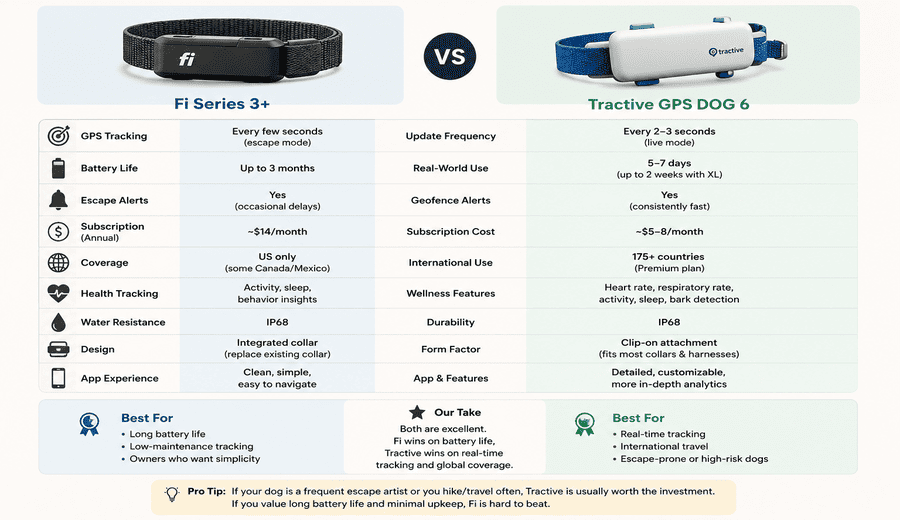
| Fi Series 3+ | Tractive GPS DOG 6 | |
|---|---|---|
| Device price | ~$99–$149 | ~$50–$80 |
| Subscription (annual) | ~$14/month | ~$5–8/month |
| Battery life | Up to 3 months | Up to 2 weeks (XL) / 5–7 days (standard) |
| GPS update speed | Every few seconds (escape mode) | Every 2–3 seconds (live mode) |
| Geofence alert speed | Fast, occasional delays reported | Consistently fast |
| Health tracking | Activity, sleep, behavior (barking, scratching, licking) | Heart rate, respiratory rate, activity, sleep, bark detection |
| International coverage | US only (some Canada/Mexico) | 175+ countries |
| Form factor | Integrated collar replacement | Clip-on attachment |
| Water resistance | IP68 | IP68 |
Want to see the latest pricing and subscription options?
GPS Accuracy: Close, But Not Identical
Both trackers use multi-constellation GPS (pulling from GPS, GLONASS, Galileo, and BeiDou satellites) and transmit over 4G LTE-M networks. On paper, they’re similar. In practice, there are differences that matter.
Fi’s GPS accuracy under open skies lands in the 6–10 foot range, which is solid for most tracking needs. The collar conserves battery by reducing update frequency when your dog is inside a known safe zone, then switches to rapid location pings when it detects movement outside the geofence. The tradeoff is that the first escape alert can sometimes be delayed—a few reviewers have noted the transition from “sleeping” mode to active tracking takes a moment.
Tractive’s live tracking updates every 2–3 seconds in active mode, which is genuinely fast—faster than anything else in the consumer GPS pet tracker market right now. That speed is Tractive’s headline advantage. When a dog bolts through a gate, you want granular, real-time position data, and Tractive delivers that.
The caveat with Tractive’s live mode: it burns through battery quickly. Continuous live tracking drains a full charge in roughly four to five hours, so it’s designed for emergencies and focused sessions, not always-on use.
For typical day-to-day tracking, both devices are accurate enough to locate a dog within a reasonable radius. The difference becomes meaningful during an actual escape, when Tractive’s faster update rate gives you a clearer picture of where your dog is moving and in which direction.
Battery Life: The Clearest Difference Between These Two
This is where Fi and Tractive diverge most dramatically, and it’s worth understanding why before deciding how much it matters to you.
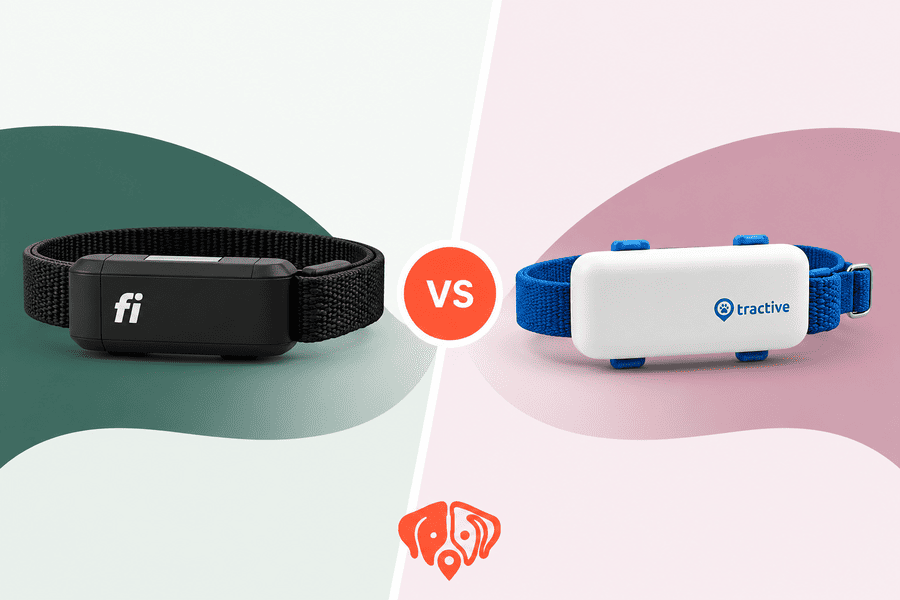
Fi Series 3+ battery life: up to 3 months. Real-world testing tends to land around 10–11 weeks under normal use — occasional walks, a yard with a geofence set, and the collar spending most of its time in power-save mode. That’s genuinely impressive. One of the most common points of failure for GPS trackers is human error: forgetting to charge, losing the cable, or the collar dying overnight. Fi’s long battery removes that variable from the equation almost entirely.
Tractive GPS DOG 6 battery life: 5–7 days standard, up to 2 weeks with the XL version. This requires weekly attention. For some dog owners, that’s a minor inconvenience. For others — especially those with busy households or dogs that are prone to escaping — it introduces risk. A dead tracker is worse than no tracker, because you might not realize it’s off.
The Tractive XL is worth considering if battery anxiety is your primary concern. Its extended range gets you closer to two weeks between charges, which is more manageable. The XL Adventure model is heavier, though, so it’s better suited for larger dogs.
Neither approach is wrong. It comes down to your relationship with charging habits and your dog’s risk profile.
Prefer longer battery life or faster live tracking? Compare both trackers directly below.
Subscription Costs: The Long Game
GPS trackers aren’t one-time purchases. Both require ongoing subscriptions to access cellular tracking, and the numbers look quite different over time.
Fi Series 3+ costs roughly $14/month on an annual plan. Over two years, you’re looking at approximately $336 in subscription fees alone, plus the ~$99–149 device cost. Total two-year spend: $435–485.
Tractive GPS DOG 6 starts around $5–8/month depending on the plan and tier. Over two years, subscription costs run roughly $120–192. Add the ~$50–80 device cost, and you’re at $170–272 for the same period.
The difference is real. If you have multiple dogs, it compounds further — Tractive offers multi-pet discounts, while Fi charges per device. If budget is a meaningful constraint, Tractive wins on total cost of ownership by a wide margin.
That said, price-per-feature isn’t the only lens. If Fi’s battery life saves you one emergency vet visit because the tracker was working when it counted, the math shifts. Think about what you’re actually paying for.
Escape Alerts and Geofencing
Both trackers let you draw virtual fences around your home, a dog park, a friend’s property — anywhere your dog has permission to be. Cross the boundary and the app notifies you immediately. In theory.
In practice, geofence accuracy is never pixel-perfect. Fi’s alerts come with a 20–30 foot buffer zone, which means the notification might fire a little early or a little late depending on GPS conditions. For most properties, this is a non-issue. If you have a very small yard that borders a busy street, it’s worth knowing.
Tractive’s geofence alerts have consistently been reported as faster in head-to-head comparisons — triggers within seconds of a boundary crossing, with less observable delay. Part of this comes down to Tractive’s more aggressive update frequency even in standard mode.
One underappreciated detail: geofence minimum size. Tractive’s minimum safe zone is larger than some urban yards, which can cause false alerts for owners with compact properties. If your dog’s roaming space is tight, test carefully in the first few days.
Fi includes a Lost Dog Mode that switches the collar to maximum tracking frequency and broadcasts a community alert to other Fi users nearby, creating a kind of neighborhood search network. It’s a thoughtful feature that’s come in handy for a number of owners who’ve posted about it online.
Cellular Coverage: Where Each Tracker Works
Fi works in the United States. It has some coverage in Canada and Mexico, but it’s not designed as an international tracker. If you travel abroad with your dog — or live near a border region where coverage is patchy — this is a genuine limitation.
Tractive works in 175+ countries. It uses an international SIM with roaming coverage across most of Europe, Australia, and beyond. If you travel with your dog, Tractive is essentially the only serious option in this category. There’s no comparison.
Even within the US, cellular coverage matters. Both trackers depend on LTE-M network infrastructure, which generally follows major carrier footprints. Rural areas with weak signal are a problem for both devices, though Tractive’s network agreements sometimes give it slightly broader rural reach. If you live on a large rural property or hike in remote terrain, test your specific area before committing.
App Experience
A GPS tracker is only as useful as the app that delivers the information. Both Fi and Tractive have reasonably polished apps, but they feel different.
Fi’s app is clean and focused. The interface centers on your dog’s location, safe zones, and activity data. Navigation is straightforward, and the escape alert notifications are clear and actionable. The community lost-dog feature is integrated without feeling cluttered. The main complaint from users is that the activity and health data could go deeper — Fi tracks steps, distance, and sleep, but it’s more of a fitness summary than a health monitoring tool.
Tractive’s app offers more data. The DOG 6 introduced heart rate and respiratory rate monitoring, which is visualized in the app alongside activity and sleep trends. If your dog has a health condition, or you’re just the kind of owner who wants a more complete picture, Tractive’s app delivers more to look at. The tradeoff is slightly more complexity — there’s more to configure, more data to interpret, and the health monitoring requires about a week of baseline collection before it becomes meaningful.
Both apps support family sharing, which is useful if multiple people share dog-walking duties. Both offer location history, though Tractive’s history length varies by plan tier — basic plans get 24 hours, while premium plans unlock a full year of location logs.
Comfort, Collar Size, and Daily Wearability
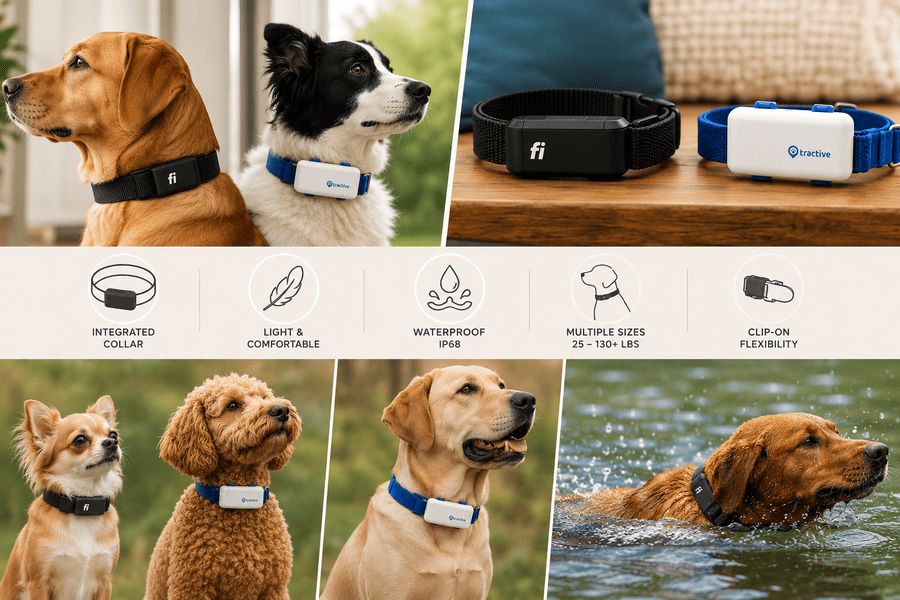
Fi is an integrated collar, not a clip-on. The tracker module is built into the collar band itself. This means you’re replacing your dog’s existing collar, and it also means the form factor is sleek and consistent — no extra bulk hanging off the side. Fi offers multiple sizes and colors, and the collar is designed to accommodate dogs from roughly 25 to 130+ pounds depending on the size selected. It sits close to the neck, which most dogs adapt to quickly.
Tractive is a clip-on device that attaches to your dog’s existing collar. The DOG 6 weighs about 1.4 ounces, which is light enough that most dogs ignore it. The silicone clip works well on standard collar widths, though some owners have noted that the clip can loosen over time—worth checking periodically. One advantage of the clip-on design is flexibility: you can move it between collars or swap it to a harness if needed.
If your dog is small (under 20 lbs), collar weight and bulk matter more. Fi’s integrated design tends to sit more comfortably on small breeds, while the Tractive DOG 6’s clip can feel disproportionate on very narrow necks. The Tractive XL is explicitly designed for dogs over 44 lbs.
Both trackers are rated IP68 — dust-tight and waterproof to 1 meter. Both have held up well to real-world conditions, including rain, mud, and swimming
Health and Activity Tracking
Health monitoring has become a standard feature expectation, and both trackers have it, though they approach it differently.
Fi’s health tracking focuses on behavioral data: steps, distance, sleep duration, and — on the Series 3+ — AI-detected behaviors like barking, licking, scratching, and eating/drinking patterns. It’s less clinical, more behavioral. The value is in noticing changes over time — if your dog suddenly sleeps much more or stops eating, the app will surface that.
Tractive’s health tracking goes further into physiological data: resting heart rate, respiratory rate, in addition to activity, sleep, and bark detection. These metrics are collected passively during rest periods. After about a week of baseline data, the app can flag significant deviations and suggest a vet check if something looks off. For owners managing a dog with a known condition — heart murmur, respiratory issues, chronic illness — this kind of data is genuinely useful.
It’s worth noting that neither device replaces veterinary care. The Tractive heart rate data in particular is useful for trend monitoring, not diagnosis. Think of it like a Fitbit for your dog — directionally informative, not clinically definitive.
Real-World Scenarios: Which One Fits Your Life?
You have an escape artist in a suburban yard
If your dog has figured out the gate latch or regularly tests the fence line, Tractive’s faster alert speed is a real advantage. The 2–3 second update frequency in live mode gives you a moving picture of where your dog is going, which matters when they’re running.
The one concern: if you charge inconsistently, a dead Tractive tracker is a worst-case scenario. Fi’s months-long battery removes that risk.
You hike or spend time off-leash in nature
For off-leash hiking, the biggest variable is cellular coverage. Both trackers go dark in areas without LTE signal. Tractive’s international SIM sometimes provides slightly broader rural coverage, but in genuinely remote terrain, neither tracker will save you.
Within areas that have cell service, Tractive’s live tracking gives you a real-time moving dot on a map, which is useful when your dog has disappeared into the trees 200 yards ahead. Fi’s tracking is reliable but typically updates less frequently in normal mode.
You travel internationally with your dog
Tractive. There’s no real debate here. Fi’s coverage is US-centric, and Tractive operates in 175+ countries. If your dog travels with you to Europe, Australia, or anywhere outside North America, Tractive is the only option of the two.
You’re managing multiple dogs on a budget
Tractive’s lower device cost and subscription pricing, plus multi-pet plan options, make it significantly more affordable when multiplied across two or three dogs. Fi’s per-device subscription model adds up quickly in multi-dog households.
You want to set it and forget it
Fi. The three-month battery life is genuinely liberating. Charge it every season, not every week, and the collar essentially disappears into the background of daily life. For owners who forget to charge things or travel frequently, this matters
Pros and Cons
Fi Series 3+
Pros
- Exceptional battery life (up to 3 months in real-world use)
- Integrated collar design — clean, comfortable, minimal bulk
- Solid geofencing with community lost-dog mode
- AI behavior tracking (barking, licking, scratching detection)
- Reliable LTE-M tracking within the US
- No proprietary charging cable concern (magnetic base)
Cons
- Significantly higher two-year cost (~$435–485)
- US-only coverage — not suitable for international travel
- Geofence alerts occasionally delayed in transition from power-save mode
- Less physiological health data compared to Tractive DOG 6
- Collar replacement model means you lose your existing collar setup
Tractive GPS DOG 6
Pros
- Lower device and subscription cost — meaningfully cheaper over time
- 2–3 second live tracking updates — fastest in the consumer market
- Heart rate and respiratory rate monitoring
- Works in 175+ countries—genuinely global coverage
- Clips onto existing collars — flexible and transferable
- 30-day money-back guarantee lets you test coverage before committing
- IP68 waterproof, proven in field conditions
Cons
- Battery life (5–7 days standard) requires weekly charging discipline
- Clip can loosen over time — check periodically
- No integrated collar option — less streamlined appearance
- Minimum geofence size can be too large for small urban yards
- Full health features require premium subscription tier
- Health data takes ~1 week of baseline collection to become meaningful
Which One Should You Buy?
Choose Fi if:
- Battery life is your top priority and you don’t want to think about charging
- Your dog is your primary concern and you stay within the US
- You want a cleaner, integrated collar form factor
- You value the community lost-dog network
- You’re comfortable with a higher total cost for the convenience
Choose Tractive if:
- You travel internationally with your dog
- Faster live tracking updates during an escape are more important than battery longevity
- You want heart rate and respiratory monitoring
- You have multiple dogs and need to manage costs
- You prefer a clip-on that works with your existing collar
For most dog owners in the US who want straightforward peace of mind, the choice often comes down to: how much does the charging schedule bother you? If the answer is “not much,” Tractive’s value and faster tracking are hard to argue with. If the thought of a dead tracker at the worst possible moment keeps you up at night, Fi’s battery is genuinely reassuring.
Ready to pick the right tracker for your dog?
Frequently Asked Questions
Do I need a subscription for both?
Yes. Both Fi and Tractive require active subscriptions to use GPS tracking. The devices will not track your dog’s location over cellular networks without a plan. Tractive offers a 30-day money-back guarantee on the hardware, which is useful for testing coverage in your area.
Can either tracker work without cell service?
No. Both rely on LTE-M cellular networks to transmit location data to your phone. In areas without cell coverage — remote hiking trails, certain rural regions — neither tracker will update in real time. There’s no satellite backup or offline mode. If you regularly hike in truly remote areas, consider a dedicated satellite tracker like the Garmin Alpha for those trips.
Which tracker is better for small dogs?
The Tractive DOG 6 at 1.4 oz is light, but its clip-on design can look bulky on very small breeds with narrow collars. Fi’s integrated collar sits more naturally on smaller dogs, and their sizing options go down to smaller neck sizes. For toy breeds or dogs under 15 lbs, neither is ideal — check manufacturer sizing guides carefully before purchasing.
What happened to Whistle?
Whistle was acquired by Tractive in 2025 and subsequently shut down. Its hardware is no longer sold or supported. Tractive integrated some of Whistle’s health monitoring technology into the DOG 6, which is partly why the health features improved significantly with that generation.
Can I share tracking access with family members?
Both apps support family sharing — multiple people can view your dog’s location without requiring a separate subscription. This is useful for households where multiple people walk the dog or manage care.
Is the Tractive XL worth it over the standard DOG 6?
For larger dogs (over 44 lbs) or owners who primarily care about extended battery life, yes. The XL model gets up to two weeks on a charge, which meaningfully reduces the charging frequency concern. The XL Adventure adds further durability for active outdoor use but is noticeably heavier.
Can Fi track my dog if I'm away from home?
Yes. Both trackers work anywhere with cellular coverage, not just near your home. You can check your dog’s location from across the country, set geofences for new locations while traveling, and receive alerts wherever you are.
Does the Tractive DOG 6 heart rate monitoring actually work?
Based on user reports and independent testing, it works for resting heart rate and respiratory rate monitoring during periods of calm. It isn’t a clinical-grade sensor, and it doesn’t work reliably during active movement. Think of it as a baseline trend monitor rather than a precise medical tool. Changes over time—particularly significant drops in resting heart rate or respiratory rate—are the more useful signal.
Final Thoughts
After comparing Fi and Tractive more deeply, the biggest takeaway is that neither tracker is universally “better.” They prioritize different things — and those priorities matter depending on the kind of dog owner you are.
Fi is built around simplicity and long-term reliability. Its battery life is genuinely impressive, the integrated collar design feels polished, and the low-maintenance experience makes it easy to live with day to day. If you mainly stay within the US and want a tracker you barely have to think about, Fi makes a strong case for itself.
Tractive, on the other hand, feels more aggressive about tracking itself. Faster live updates, broader international support, and more advanced health monitoring make it better suited for owners who travel frequently, spend time outdoors, or simply want the most real-time visibility possible when something goes wrong.
In many ways, this comparison comes down to one question:
Do you care more about charging less often or tracking more aggressively during an escape?
For some owners, Fi’s battery life will outweigh everything else.
For others, Tractive’s faster live tracking and global coverage will matter far more.
And honestly, that’s why these two products continue to dominate the GPS dog tracker conversation in 2026 — because both are genuinely good at different things.
Lorem ipsum dolor sit amet, consectetur adipiscing elit. Ut elit tellus, luctus nec ullamcorper mattis, pulvinar dapibus leo.